Completed Event: Women's Basketball versus UCLA on March 29, 2026 , Loss , 58, to, 70
/
Final

Women's Basketball
58
vs UCLA
70
10/26/2005 12:00:00 AM | Women's Basketball
Q&A Provided by GBallMag.com
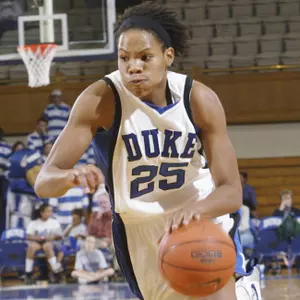
Monique Currie is in her fifth season at Duke, after sitting out her second year with a torn ACL in her left knee. Last year, she was a finalist for the John R. Wooden Award, State Farm Wade Trophy and Naismith Trophy for National Player of the Year; finished second for the Wooden Award.
Currie is only the third Duke player to record over 1,500 points, 650 rebounds and 300 assists in a career. Last year, while averaging 17.5 ppg., 7.1 rpg., 3.4 apg., and 2.1 spg., she earned honors on four All-America teams, and was named Atlantic Coast Conference Player of the Year. The 6-0 guard/forward led the ACC in free throws made (168) and attempts (215).
In her second full season (2003-04), she averaged 12.3 ppg., 6.1 rpg., 3.0 apg., and 1.6 spg.
As a freshman, she was named to the Freshman All-America squad, and earned ACC second-team honors. She was selected as the ACC Tournament MVP after recording career highs in points (30) and rebounds (12) vs. North Carolina in the championship game.
Last summer, she helped the USA Women's World University Games team to a 7-0 record, averaging 6.3 ppg., 3.9 rpg., 1.6 apg., and 1.3 spg. She started two of seven games.
Gball: How did you get started in basketball as a youngster, and what did you do to prepare yourself for a future career on the hardwoods?
Currie: I started playing organized ball in recreational leagues, but I had always played in my neighborhood with my friends. I've always been around basketball, as my dad played recreational ball, and I would always go with him to the park. I really didn't think about preparation for the next level, although I did play AAU ball, and this definitely helped me as I progressed up the ladder to college.
Gball: Did you play other sports at The Bullis School before you went to college?
Currie: I played field hockey in high school for two years. We didn't have gym class, so you had to play at least two sports.
Gball: Tells us about the recruiting process as you thought of going to college, and why did you choose Duke?
Currie: It seems so long ago. The recruiting process definitely was a new experience for me. I received tons and tons of mail, and had to make one of the most important decisions of my life. My family helped me, and my coaches were there for me so that I was able to narrow down the list to the few schools in which I was interested. I pretty much didn't want to go far away from home. I grew up around the ACC, and I felt I wanted to play in the ACC so that made the choice even easier. Eventually I began taking visits to see where I felt the most comfortable, or where I could be most successful. Duke ended up being all that I wanted in a school.
Gball: What do you have to do to become an elite player at the Division I level?
Currie: You have to continue to work hard and listen to your coaches. Every time you step on the floor, you want to get better because you know someone else out there is working hard because they want to be where you are if you are a Division I athlete, and they are ready to challenge you. You must stay dedicated to what you are trying to achieve and accomplish, and worry about the things you can control.
Gball: Being named to the freshman All-America team highlighted your freshman year at Duke, and you were named ACC tournament MVP. How bad was it for you when you tore your ACL in an exhibition game before your sophomore season?
Currie: It was definitely awful because I was really looking forward to my sophomore campaign. I thought I had worked hard over the summer, and I was prepared for another season. But just like that, it was taken away from me quickly and I had to deal with it. I would have loved to play that season, but everything happens for a reason, and it just opened up other opportunities for me, and I had a chance to come back this year to accomplish some goals.
Gball: While sitting out your sophomore year with the ACL injury, what did you learn while watching from the bench?
Currie: I learned about my dedication to basketball and how much I missed it, and wanted to be out there playing. I re-committed myself to being the best I could be. In addition to that, I listened to the coaches to see how they called plays and how they strategized. I watched a lot more film that year with the coaches. I just got a prospective from the other side being off the court, which is entirely different than being on the court.
Gball: Last year's Duke team was called Monique Currie's team. What did that mean to you, and was that a fair assessment?
Currie: I wouldn't necessarily have called it Monique Currie's team. I think it was Duke women's basketball. I say that because I can't win a game by myself. I have a great cast of players around me, a great coaching staff, and I couldn't be successful without those people. I was a leader for the team, and I can go with that, but that was the extent of that being my team. I try to lead my team and help us be as successful as we possibly can.
Gball: You've been described as a versatile player, one who can play inside, but still able to come outside to shoot the 3. What is the best quality of your game? What do you do best?
Currie: I think I just get after it. I'm an aggressive player, and I like to go to the basket and score with contact, or just rebound the ball. Those are my strengths and what I go to the most. I know I can always get to the basket someway, so those are my strengths.
Gball: You are a good foul shooter. What is the key to being successful at the free throw line?
Currie: Repetition. You have to get a lot of free throw shooting in. I want to do the same thing every time I shoot a foul shot. Once you get that repetition down, it becomes a natural motion when you shoot the ball. If you do what you are accustomed to doing it should go in.
Gball: You hit game-winning shots at Tennessee, N.C. State and Maryland last year. What is your thought process when it becomes crunch time?
Currie: I want the ball during crunch time. I think I perform best under pressure. I trust what Coach G. calls at the end of the game, and I know that my teammates will set good screens for me. If I'm open, I feel that I can hit the shots. If I come off these screens like I'm supposed to, we should get a good look at the basket and capitalize on that.
Gball: Tell our young readers how you have been able to mix athletics and academics together to be successful in both ventures.
Currie: It definitely takes managing your time and managing your schedule. Basketball definitely takes up a lot of time. To be successful in basketball, you have to also succeed in the classroom. There are only so many hours in a day, and you have to do what is important, which is your schoolwork. If you want to play, it is key to manage your time to do a sufficient amount of schoolwork to be successful.
Gball: You graduated from Duke, and are now playing as a grad student. Is this a different way of life for you?
Currie: It's not so different, although in graduate classes, I'm with different kids. In the classroom, I'm usually with older students, but basketball wise, it is pretty much family. I'm a lot older than most of the players--five years older than the youngest person.
Gball: What made you return for a fifth year when you probably would have been a first round draft choice in 2005?
Currie: There was a combination of things that went into it. Most importantly was another opportunity to win a national championship, and that has definitely been an ultimate goal of mine or any other college player. Just to know that it is a possibility with a great team and a great staff was enough lure for my return. I graduated in May, and I was able to begin working on a master's degree, and that was another reason why I came back.
Gball: You describe yourself as intense on the court, but yet mellow when you are not competing. What do you do to make this transition?
Currie: I don't know. My personality off the court is a lot different than it is on the court. I've run into a lot of players I have
played against, and they say you seem so aggressive and tough on the court. I'm not like that at all off the court. I'm silly sometimes, but I really keep to myself, and I am quiet most of the time, I guess. I'm shy to some extent, but this is how I transfer my aggressiveness to the court.
Gball: Last summer you played for the USA in the World University Games. Tell us about that experience.
Currie: That was definitely a great experience. Just to be able to practice with some of the best players in the country everyday will only allow you to get better. I learned from the other players, and we definitely had a lot of fun. It was an adjustment for me because I was playing in a new system with Kathy Delaney-Smith, so I thought that was good for me because if I'm able to go to the WNBA next year, I'll probably have to adjust to a new system. So, just learning how to adjust to a new system, and playing with different personnel that I'm not used to playing with was definitely a learning experience.
Gball: Preseason polls have Duke listed No. 1 in the country. How do you feel about that?
Currie: It's definitely an honor, but I've been here awhile, and I know how trivial preseason rankings are. I was just thinking the other day about how many teams have been ranked No. 1 in preseason and actually won the national championship. I just know we want to be ranked No. 1 at the end of the season. It's just something we know we must maintain, and that teams will really be coming after us because of that national ranking. We just have to continue playing good Duke basketball, be intense, and try to get better each day.
Gball: Besides playing in the WNBA, what's in store for the future for Monique Currie?
Currie: I'm not entirely sure, but a lot of my classes have to do with education policy or health policy. I love kids, and I think I want to work with kids in some form. I don't know if I necessarily want to teach, but dealing with kids is something that has to be a part of my life eventually.
Interview conducted by Gball Editor Dave Wohlhueter