
Completed Event: Men's Soccer at #14 Akron on November 30, 2025 , Loss , 0, to, 2
/
Final

Men's Soccer
0
at #14 Akron
2
9/27/2006 12:00:00 AM | Men's Soccer
By John Roth, Blue Devil Weekly
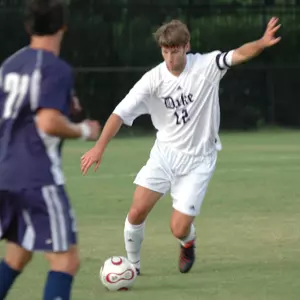
DURHAM, N.C. - Chris Loftus and some of the other veterans on the Duke soccer team admit there's a chip on their shoulders this year.
They've enjoyed two outstanding postseason accomplishments the past two seasons in reaching the 2004 College Cup (final four) and winning the 2005 ACC Tournament.
But each of those highs was followed by a numbing low.
In the 2004 NCAA semis they were drilled by UC-Santa Barbara 5-0 in a match Loftus describes as "embarrassing for us in front of the entire nation."
Then last year their title in the nation's most difficult conference tournament was followed by an upset loss to Creighton in their NCAA opener. "Guys still talk about the game to this day," Loftus says. "Losing that and seeing a lot of the other upsets that happened, we realize we could have gone far."
The hope and plan is to go very far this year, which is one reason why senior midfielder and two-time captain Loftus didn't play soccer at all last spring. After noticing a sharp pinch in his hip during a pickup game the first week after the Christmas holiday break, Loftus was consumed with the desire to be healthy for his final season. That led him on a six-month journey through medical science that presented him with many options and ultimately had him back on the field when the season opened last month.
Loftus initially thought he had a strained hip flexor and went to Duke physical therapist Nick Potter for flexibility and hip rotation treatment. He also started taking yoga classes in Chapel Hill. He felt the hip was getting better, but when he'd test it on the field it still seemed aggravated, and he could feel it click during certain movements.
An MRI detected a small tear in the rim of cartilage around the hip joint, likely caused by a pinch from the equivalent of a bone spur on the head of his femur. Surgery would solve the problem, but with a minimum three-month recovery time, Loftus was leery about getting back in time for the season. The condition was nearly identical to the one sustained by former Duke basketball player Shavlik Randolph, who had surgery following his freshman season, was out of action the entire summer and didn't reach a satisfactory level of fitness until well into his sophomore year.
"It's complicated," Loftus explains. "They have to take your bone out of the socket and shave it down, and it was something I was scared to do. I was just not excited at all to get this done."
Loftus' older brother Jason, a former soccer player for Illinois, is a medical sales rep who knows several doctors. One of them took a look at Loftus' MRI on a DVD, tested Loftus' flexibility during a weekend visit home to Illinois, and told him he didn't think surgery was needed.
Armed with that opinion, Loftus returned to Duke and launched into an exhaustive hip rehabilitation program with Potter in late April. The two spent from one to three hours a day together for six straight weeks, going through a very specific progression of hip exercises developed by Potter during his treatment of several similar patients.
"What we did was a lot of joint manipulation and mobilization to create more mobility within the hip joint itself and then retrain his muscles to fire in a different manner to prevent it from pinching again," Potter explains.
"You start with mobilizations, then there are these exercises where you try to activate one particular muscle and turn off another one, where you are trying to create a certain firing pattern and muscle balance. When you've done that you can then work on more general strength training and endurance, then from there progress to functional stuff on the field, soccer drills and all that."
The treatment had Loftus healthy enough to play in Duke's exhibition games in Germany during a World Cup trip in June.
When the Blue Devils returned, Loftus was able to play for a summer league team in Raleigh and was soccer-fit for the start of Duke's training camp in August. "The pain was gone, and it stayed gone," he says. "I owe a lot to Nick Potter. It worked out for the best."
Potter credits Loftus for asking questions and considering all options, and the teamwork displayed by all the members of the Duke sports medicine program, from physicians to trainers to therapists. "Everyone was on board, they knew what was going on and were in agreement with the plan, and that was quite helpful. It worked out pretty well," he says.
On the field this fall, Loftus hasn't yet played the minutes he was accustomed to in the past, but not because of his health. As coach John Rennie has made some adjustments in the team's style of play, Loftus has had to take on some different roles, mostly in a defensive midfield capacity off the bench. But he has been solid lately, including a sharp assist on the game-winning goal in Duke's 4-3 decision at Wake Forest in the ACC opener.
Duke will need his contributions to continue progressing toward another prosperous postseason, which Rennie says will only happen if the proper steps are taken day by day.
"Our focus is on being a very strong team defensively, being more consistent and doing well in our league," says the veteran coach. "If we do that, we'll have a good season and have a great chance to do well in postseason play. That's what our focus has to be, because if you don't, you won't get to those opportunities."


