Upcoming Event: Men's Tennis at #42 Miami on April 5, 2026 at 3 p.m.
/
3 p.m.

Men's Tennis
at #42 Miami


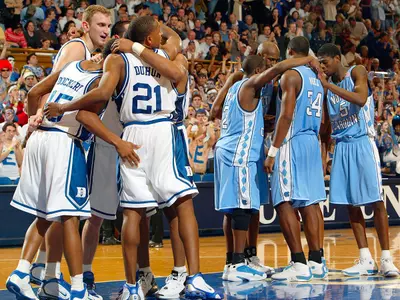
9/28/2007 12:00:00 AM | Athletics
DURHAM, N.C. ? For a sports and political junkie like me, the year preceding a presidential election is about as good as it gets. A new season of college sports coincides with a new crop of political recruits, giving opinionmakers in both mediums the chance to unleash a fresh batch of clich?s and comparisons, so much so that Senator John McCain recently pointed out, “Politics is all sports metaphors.”
Of course, everything a politician does is calculated, and so every time a politician uses athletics to make a point, a purpose is being served. And that purpose is to relate to potential voters. In the United States, because of the singular place sports holds in our ever-competitive society, there is no better way to do that than by intertwining politics and sports.
There's much more to this than rhetorical gamesmanship, however. The way Americans attach themselves to sports teams is borne out of something innate, something very similar to how people attach themselves to their place of birth, to their country. And it is for this reason ? this parallel between sports fandom and ethnic identity ? that our elected officials continuously and effectively embrace the language of athletics when politicking.
The proof of this phenomenon resides in a classic work of political science by the James B. Duke Professor of Law and Political Science, Donald Horowitz, whose complex language can be filtered through the Duke-North Carolina rivalry, and the fans whose lives have been changed by it. This comparison can be made because fans of Duke and North Carolina have feelings similar to those that Americans in general have for their country. Or as Horowitz writes in his tome Ethnic Groups in Conflict, "In divided societies, ethnic affiliations are powerful, permeative, passionate and pervasive." Undoubtedly, fandom is defined by "powerful, permeative, passionate and pervasive” emotions.
But first, we must ask how fans arrive at such emotions for one team versus another. And we must do this by asking how people come to associate with one ethnicity versus another. Political scientists have two answers, both of which are determined by geography and circumstance.
If you're born in Chapel Hill, for example, you're “Tar Heel born and Tar Heel dead.” Irish? Italian? Indian? Irrelevant. Your parents were UNC grads, you grew up cheering for Michael Jordan, and you ended up graduating from UNC, as well. You had no choice but to be a Tar Heel. It was in your blood. Political scientists would describe this as primordialism.
For others, it's more complicated. At some point, a connection is made to a team, and an affiliation develops in time. Maybe you fell in love with Grant Hill or Shane Battier, thanks to the power of ESPN. Or perhaps Duke was the best school to which you were admitted as a high school senior. But being a small private school without broad market appeal, few other than the children of alums or professors are “born” as Blue Devils. Political scientists would say these fans have developed their affinity for Duke through constructivism.
Further complexities then ensue in the form of double consciousness, if you will, between rooting for a hometown team, and an altogether new one.
Consider the example of the Robertson Scholars, a collection of students raised in North Carolina who study at both UNC and Duke. Half of this intrepid group spends the bulk of their undergraduate career at UNC, but at least a portion of their time is spent on campus at Duke, studying and cheering alongside their full-time Blue Devil classmates. This two-ness manifested itself most obviously in the winter of 2006, when a bold group of Robertson Scholars, disguised in Blue Devil attire, passed as Duke fans while tenting for the Duke-Carolina basketball game, waiting until tip-off to come out of their cocoons replete in Tar Heel regalia. In response, the Duke Student Government rescinded the right to tent from all UNC-based Robertson Scholars.
This simple display of fandom demonstrates the extent to which people will go to serve their teams. And the height of that servitude comes whenever the teams play one another. And yet, the basic differences between the loyalty to a team and the loyalty to a country are negligible. “Ethnic allegiances are usually revived by the wartime experience,” Horowitz writes. Indeed, games are the equivalent of a “wartime experience.” The Spartans and Greeks waged battle on the fields of war; The Blue Devils and Tar Heels do so on the fields of play. In both circumstances, the competition draws the attention of the masses, and the fans cheer for their side accordingly.
Or as long-time Duke men's soccer coach John Rennie explains, “The main thing about the game is that the players are aware that there is much more public interest in any Duke-UNC contest than in almost any other game of the season. Players and coaches know that a lot of people will know the result and that we'll all hear about it ? win or lose. Attendance will be great, the fans will be louder, and there will be lots of spectators from both schools.”
All those spectators do not have to travel very far to support their side, a fact that is often said to exacerbate the rivalry's intrastate intensity. Once again, Horowitz's study of ethnic conflict explains why: “Ethnic divisions pose challenges to the cohesion of states and sometimes to peaceful relations among states. Ethnic conflict strains the bonds that sustain civility and is often at the root of violence that results in looting.”
Duke and Carolina fans don't exactly loot one another's campuses, but they do their fair share of pillaging on their own. Consider: If Duke beats UNC in men's basketball, students pour onto the Main Quad on West Campus and build a gigantic bonfire, complete with wooden benches and dorm furniture hurled upon the flames. Or if the win comes in football, fans take down goal posts, as Duke students did in 2004 when the Blue Devils won in Chapel Hill. Similarly, UNC fans have been known to overrun Franklin Street after wins against Duke, overturning cars and the calm of Chapel Hill along the way. (Of course, none of this compares to the riotous shenanigans in College Park after wins and losses alike, but I digress.)
The questions persist, however, as to how and why two groups of people can detest the other so immensely. The recycled answers are well-known: Both Duke and UNC have lofty and long-standing athletic traditions, so much so that whenever the schools compete, championships hang in the balance. It's not exactly a fight to the death, but in a sense, a Darwinian struggle ensues: for recruits, for facilities, and so forth.
Coaches tend to handle this a little better than fans, however. Consider the example of women's lacrosse coach Kerstin Kimel, whose counterpart Jenny Levy at UNC is one of her best friends.
“Our husbands play golf together, our children get along great, we go on vacation together,” she says.
But even so, the rivalry rears its head come game time ? even when the contest isn't in lacrosse. Kimel recalls the Duke-North Carolina men's basketball game in 1998 as one of the best examples of this.
“We were playing in an annual round-robin tournament at UNC on this day, and our team was huddled around the radio listening to the game before we were scheduled to play Virginia Tech,” she said. “As the game came down to the wire, the UNC staff put it on the loudspeaker system so everyone could hear it. When we won at the last second, our team and parents went crazy and celebrated. We then promptly ran onto the field (with no warm up) to play Virginia Tech. Later, the team begged me to drive them to Franklin Street so they could run down the street in their Duke uniforms and celebrate, which of course I was happy to let them do.”
The source of such competitiveness parallels the struggle ethnic groups have faced throughout the course of history. Or as Horowitz notes: “It is asserted that the competition for scarce values and material goods is exactly what propels people to see themselves as members of distinct ethnic groups, whose interests conflict with those of other ethnic groups.” Duke fans want their interests met; UNC fans want the opposite, and understandably so. That struggle doesn't bring out the best in people, either ? survival of the fittest, and all. Indeed, looting isn't the only byproduct of an athletic rivalry: Biting rhetoric is, too. Fans hurl insults back and forth, a communiqu? so common that it's earned its own nickname: “trash talk.”
This, too, has its roots in ethnic conflict.
“In one country after another, other ethnic groups are described in unflattering or disparaging terms,” Horowitz writes. “In general, ethnic identity is strongly felt, behavior based on ethnicity is normatively sanctioned, and ethnicity is often accompanied by hostility toward outgroups.” And nowhere is that hostility on clearer display than in North Carolina graduate Will Blythe's recent book, To Hate Like This Is To Be Happy Forever: A Thoroughly Obsessive, Intermittently Uplifting, and Occasionally Unbiased Account of the Duke-North Carolina Basketball Rivalry. Blythe's ode to odiousness cannot be shrugged off as deriving from ignorance: He is no simpleton, having served as an editor at Esquire and a contributor to many of the nation's top literary publications. But his loathing of Duke is as uncompromising as anyone's.
In the book, Blythe explains that he inherited his distaste of Duke from his father. Or rather, it was inherent.
“Duke is the university as a launchpad, propelling its mostly out-of-state students into a stratosphere of success,” Blythe writes. “While hardly opposed to individual achievement, North Carolina, by contrast, is the university as old home place, equally devoted to the values of community and local service. That, at least, is the mythology many of us swallowed as we grew up. So that when one roots for one team or another in the Duke-North Carolina rivalry, one is cheering as much for opposing concepts of American virtue as for adolescent geniuses of basketball.”
And so it all comes back to geography and environment, and the challenges of being pulled in opposite directions by two competing allegiances, a two-ness that reflects the struggle for identity itself.
Or as Blythe writes: “Issues of identity--whether you see yourself as a populist or an elitist, as a local or an outsider, as public-minded or individually striving--get played out through allegiances to North Carolina's and Duke's basketball teams. And just as war,[it] is a continuation of politics by other means, so basketball, in this case, is an act of war disguised by sport. The living and dying through one's allegiance to either Duke or Carolina is no less real for being enacted through play and fandom.”
Living and dying is something politicians do by gauging the winds of public opinion and acting accordingly. And so with sports gusting consistently across the landscape, politicians attempt to capitalize on the sports affiliations of their constituents in order to gain their favor--or to undercut their opponents.
Consider the example of John Edwards, a former senator from North Carolina who attended UNC Law School and proudly told a prominent newspaper amidst his presidential run in 2004 that he hated Duke Basketball. Since nothing a politician does is without calculation, it's fair to assume that Edwards believed that expressing himself in such a way would bring him favor not only among his former constituents in North Carolina, but across the country, where a rising tide of anti-Duke fervor had been rising for some time. Despite those efforts, Edwards lost not only the presidential primary, but also failed to deliver his home state as the vice presidential candidate on the Democratic ticket.
His divisiveness having proven ineffective, Edwards ? once again seeking the presidential nod ? recently spoke more positively of the joy he took in winning a game of horse against North Carolina's beloved former point guard, Raymond Felton. “I love finding people who never heard this story!” Edwards crooned in Esquire magazine. And Edwards is banking on the fact that voters will love hearing it.
Then again, as Horowitz writes, divisiveness isn't necessarily ineffective. “In societies where ethnicity suffuses organizational life, virtually all political events have ethnic consequences. Where parties break along party lines, elections are divisive.”
Perhaps a politician like David Price holds the key to quelling such divisiveness. An honors graduate from North Carolina, Price earned a PhD in political science from Yale before arriving at Duke, where he taught for several years, and where he sent his two children for college, before beginning a career as a congressman for the 4th District of North Carolina. He handles his fandom diplomatically, having been known to say, “Whatever the outcome of a Duke-UNC game, it's a win-win.”
With answers like that, it's no wonder Price is in the middle of his tenth term in Congress. A Tar Heel grad, but a Duke professor and dad: Evolution is a wonderful thing.
The views expressed in this column are solely those of the writer and do not necessarily reflect those of Duke University or the Duke University Department of Athletics.


