Upcoming Event: Football versus Blue & White Game on April 18, 2026 at 2 p.m.

Football
vs Blue & White Game


10/1/2009 9:15:00 AM | Football
DURHAM, N.C. – Quarterbacks usually get most of the attention on passing teams. But receivers are equally important.
Steve Spurrier is renowned as a quarterback guru, but in his days at Duke, the former Heisman Trophy winner coached two wide receivers who earned ACC player of the year awards – Chris Castor in 1982 (when Spurrier was Red Wilson's offensive coordinator) and Clarkston Hines in 1989.
When noted QB mentor David Cutcliffe took over the Blue Devil program after the 2007 season, he inherited one of the best receivers in Duke history. Eron Riley didn't win ACC player of the year honors, but he did finish his career as the second-leading receiver in Duke history (2,413 yards) and was third in career touchdown catches (22).
There's no one on the current roster putting up numbers quite like that, but Cutcliffe suggested recently that Duke's collection of wide receivers is actually more productive that last season's Riley-and-company.
“What we haven't had here is what you call a receiving corps,” he said. “I think we're developing a receiving corps.”
Through Duke's first four games, Duke's quarterbacks have completed passes to 13 players – three running backs, three tight ends and seven different wide receivers. Significantly, the top four receivers in both receptions and yards gained are all wide outs.
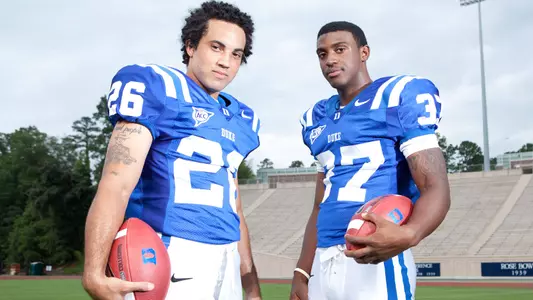
It's a youthful quartet, featuring one junior, two sophomores and a freshman:
“The receiver corps is young, but you have guys who can make plays – like Conner Vernon, Johnny Williams, Donovan Varner and Austin Kelly,” quarterback Thaddeus Lewis said. “It's not like you can go into a game saying, 'You know, we've got to key on such and such guy' because any one of those guys can have a breakout game, because they all have the talent to do it.”
Leon Wright, Duke's senior cornerback, has gone up against Duke's receiving unit in practice and he can compare them with the receivers he battles on Saturday's in the ACC.
“They all bring something to the table,” Wright said. “You have Johnny, he's the speed guy, real quick. He's a little bigger, but he's short. He's a big play threat. Then you have Donovan on the inside, who's also a small, speedy, quick receiver, who is also a big play threat. Then you have the bigger receivers that are more possession receivers.
“The only thing different is that some ACC receivers are a little bit bigger, but I feel like in speed and knowledge, they're the same.”
Lewis has no problem with the size of his primary targets.
“They're fast – they're very fast,” he said. “Johnny can run by a lot of guys. Donovan can as well. It ain't the size of the dog in the fight, it's the size of the fight in the dog. Those guys go out there and lay it on the line and play big. We've got two bigger targets in Austin and Conner and we've got those fast, shifty guys like Donovan and Johnny in the slot. That creates problems for a linebacker. We try to put those guys in position where they can cause problems.”
Size was an issue when the 5-foot-10 Williams was being recruited. Although he was one of the most productive prep receivers in Alabama – earning first team all-state honors and leading Leroy High School in St. Stephens to back-to-back 2-A state championships – Williams didn't attract a lot of attention from the SEC powers that surrounded his home. His only firm scholarship offers were from Alabama-Birmingham and Memphis.
But there was an assistant at the University of Alabama who loved Williams' game. Ron Middleton looked past the height issue and saw the speed and raw athleticism that made the young receiver so successful. He was never able to get head coach Nick Saban to pull the trigger on a scholarship offer, but in late December, Middleton got a chance to join Coach Cutcliffe's staff at Duke.
One of his first contributions to the program was to convince Cutcliffe to visit Williams in Alabama. The new Blue Devil coach was visiting the Williams' home when he saw something that made him a believer.
“I'm standing out in the backyard and I see they've got a basketball hoop on an oak tree,” Cutcliffe said. “I said, 'I think that hoop is too high.' Johnny picked the ball up and standing flatfooted, jumped up and dunked it with two hands. He said, 'No, we measured it when we put it up and it's exactly 10 feet.' I asked him when they nailed it up and he said about three years earlier. I reminded him that trees grow – that hoop was six to eight inches higher than 10 feet.”
As Williams recalls the incident, Cutcliffe watched him do his standing dunk, then said, “'Wow!' He wanted to go meet my mom after that.”
When Williams got the offer from Duke, he jumped at it – maybe not 10-feet, 8-inches, but high enough.
“Coach Middleton called me,” Williams said. He explained that he didn't realize at first that his Alabama recruiter had gone to Duke. “He called me and I had never seen his [new] phone number and I was like, 'Who is this?' and he said, 'Coach Middleton,' and he said 'We're offering you.'
“I thought it was Bama, then he said, 'for Duke' and I was like 'Duke? I can't wait to come.' I just put the phone down and ran to tell my mom.”
Williams made Middleton look like a genius with a productive freshman season that saw the first-year player catch 30 passes (second only to Riley) for 327 yards. He and the 5-foot-9 Varner – hurt early, but who returned to catch 10 passes in the finale against UNC – showed their promise in 2008.
This year, they've teamed with Kelly, who caught 28 passes for 328 yards and a touchdown in his first two seasons at Duke, to provide an experienced core for the 2009 receiving corps.
“I feel like we've got a lot of experience because Donovan and Johnny, they played a lot last year,” Kelly said. “And I played my freshman year and my sophomore year. This is my third year. I feel like the guys with that game experience can help a guy like Conner out ... just let him know what it's like.”
So far, Kelly has been impressed by his young compatriot.
“He's been in there making plays,” he said of Vernon. “He has a playmaking mentality. I don't think the age really matters.”
Actually, it wasn't an easy transition from high school to college for Kelly. The 6-foot-2, 200-pounder played quarterback for most of his prep career at Austell High School in Mableton, Ga. He only switched to wide receiver late in his senior season.
“It was tough coming out of high school, transitioning after playing quarterback in high school,” he said.
Still, he was getting recruiting attention from Georgia Tech, Memphis and South Carolina before he made a very early commitment to Duke.
“My mom and Dad really like the school and what I could get after football,” Kelly said.
Although he played his first season under former coach Ted Roof, Kelly was delighted when Cutcliffe took over the program.
“It was definitely a big change,” he said. “I knew about Coach Cut when I was in high school and he was at Tennessee and Ole Miss. I was really excited to get to play for him.”
Kelly already has more receptions this season than in either of his previous two years. And even though he has turned in Duke's longest pass play of the season and has the best per catch average of any wide receiver, he still considers himself more of a short-range target.
“I guess I'm a little bit of a possession receiver, but I feel like I can make plays on deep balls,” he said. “Just catch everything – that's our number one goal, catch everything thrown at you. So far we're doing a good job at that.”
Kelly is enjoying his role as one part of Duke's developing receiving group.
“I think it makes it a lot more difficult for the defense,” he said. “You've got to look out for four or five guys, instead of focusing your attention on one. It takes the pressure off me – it doesn't put pressure on any one of us. We've all got confidence in each other. We've got confidence that when the ball's thrown our way, we're going to make the play.”
Although Kelly is the biggest of Duke's top four receivers, he doesn't think that lack of height is any detriment to his shorter teammates.
“I think the smaller guys – Johnny and Donovan – those guys are slippery,” he said. “If we get them out in space, they're hard to tackle. Did you see Donovan the other night [break several tackles en route to his second TD catch against N.C. Central]? It's hard to tackle him. Johnny is the same way. Those are the guys we want to get out in open space and force people to tackle them in the open field.”
Lewis also likes the way his receivers run after the catch.
“We have some guys that can get what Coach Cutcliffe calls the dirty yards,” the senior QB told the Duke Chronicle in a preseason interview. “These receivers are willing to lower a shoulder and are capable of making somebody miss in the flats to pick up a couple of extra yards or break even bigger gains.”
So far, so good, although Coach Cutcliffe would like to expand his receiving corps. He'd like to see his tight ends catch more balls – two of Brett Huffman's four catches have gone for touchdowns; Brandon King had four TD catches in 2007 before he was hurt and missed the 2008 season. And Duke has barely scraped the surface of freshman Tyree Watkins' talent (seven catches for 48 yards).
It's encouraging that all four of Duke's top wide receivers this season will be back next season. In fact, the only senior who has caught a pass this season is running back Re'quan Boyette. Everybody else will be back – meaning that as good as Duke's current receiving corps looks this season, it will only be better a year from now.
“It's going to be a bright future for this receiving corps,” Kelly said. “We've just got to continue to be more consistent and to keep working.”


