Upcoming Event: Football versus Blue & White Game on April 18, 2026 at 2 p.m.

Football
vs Blue & White Game


11/26/2010 1:47:00 PM | Football
By JIM SUMNER
Duke football coach Wallace Wade won a lot of games during his early years in Durham; 85 in his first 11 years to be exact. Not many of those wins took place when Duke was a decided underdog. It wasn't that Duke couldn't win as an underdog. They just didn't find themselves in that position very often.
But Duke was a decided underdog when North Carolina visited Duke on November 16, 1935. Duke wasn't that bad. The Blue Devils entered that game with a 6-2 record and wins over South Carolina, Clemson and Tennessee. The losses were 6-0 to Georgia Tech and 7-0 to Auburn.
North Carolina, on the other hand, came into the game with a 7-0 mark, having outscored opponents 209-19, with five shutouts. The Durham Morning Herald wrote that Duke "had little chance to stop Carolina's flying rush toward national honors." The oddsmakers made the Tar Heels 4-1 favorites, while the Rose Bowl had them at the top of their wish list. All they had to do was defeat Duke and woeful Virginia.
The match received extensive attention. NBC broadcast the game nationally, several news-reel organizations set up shop and extra bleachers were added.
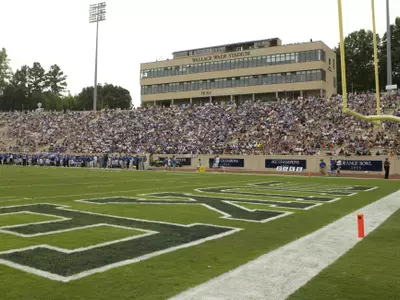
Despite a chilly rain, a crowd of 46,880 filled the Duke Stadium. It was the largest crowd to ever see a college football game in the South.
Wade wasn't remotely ready to concede supremacy to the visitors. The 43-year-old coach was so fired up that he practiced as a lineman with his team. He also devised a plan to stop Carolina's high-flying offense, which was led by Don Jackson's passing to star ends Dick Buck and Andy Bershak. Wade had his ends Richard Talliaferro and Ed West shadowed Buck and Bershak every step of the way, conceding short gains but eliminating the home run.
It worked to perfection. In fact, it was Duke that pulled off the big plays.
Game conditions were miserable. The teams combined for 11 turnovers, eight by Carolina. The Tar Heels put together an 87- yard drive in the first period, but missed a short field goal. This wasn't unusual in the pre-specialist era.
Opportunities were squandered early. Duke fumbled at its 37, but got the ball back on an interception. Duke took over at the UNC 19 following a blocked punt, but lost the ball on a fumble.
The first score came in the middle of the second quarter. Carolina punted to its own 47. On the next play, Duke's Jule Ward took the ball on a reverse around left end. Sam Gardner's block took Bershak out of the play, and Ward sprinted untouched into the end zone. The extra point was missed.
Duke had a chance to extend its lead in the dying seconds of the second quarter. Jack Alexander ran 78 yards to the UNC 10. After an incomplete pass, Ace Parker carried to the two. A third-down run fell short, and the clock ran out before Duke could run another play.
Ace Parker was a junior in 1935 and he had few better games. He was a master runner, defender and punter. The latter talent was crucial this day. In the second quarter, he got Duke out of a hole, launching a 68- yard punt from the Duke one.
He matched that in the third period, dropping a punt at the UNC two. Carolina tried to pass, but 152-pound Don "Rabbit" Hennemier picked off Jackson and returned the ball to the three. Three plays later, Alexander pounded over for the score. Gardner converted the extra point and Duke led 13-0.
Trailing by two scores in a driving rain placed Carolina in catch-up mode. Jackson connected often enough to move the ball, but the Duke defense kept forcing turnovers. Parker stopped one third-period drive by recovering a fumble at the Duke 25.
Carolina's last gasp came early in the final quarter. The Tar Heels drove to the Duke 14. But Alexander stepped in front of a Jackson pass and returned it 90 yards for the score that ended Carolina's Rose Bowl dreams. A John Johnston block on Jackson near midfield sprung Alexander.
Duke added a fourth touchdown in the final minute when Parker scored from 30 yards out. Ward set up the score with an interception and long return.
The final was 25-0.
North Carolina had 13 first downs to Duke's five and outgained Duke 260 yards to 228. But the turnovers and Duke's three long scoring plays doomed them to defeat.
Parker was the star of the game. He played 57 minutes, rushed for 78 yards and most importantly averaged 44 yards on 12 punts, an extraordinary accomplishment under the conditions. By contrast, UNC averaged only 30 yards for its 9 punts.
Jack Alexander led Duke with 96 rushing yards. Carolina's passing attack could net only 78 yards, completing 9-of-28 passes and throwing five interceptions.
Duke defeated North Carolina State the following weekend to end the season 8-2, while North Carolina defeated Virginia to finish 8-1. Neither team received a bowl invite; there were only four bowl games in 1935.
It's not clear if UNC would have accepted a bid. University president Frank Porter Graham was a critic of what he deemed the over-commercialization of college athletics. But Duke made sure the debate never took place.
Wade said after the game that Duke "had one great game in its system and got rid of it Saturday."
Perhaps. But it was no accident, a fact recognized at the time. Anthony McKelvin of the Raleigh News and Observer called Duke "a team which had the courage, aggressiveness and stamina to drop from the ranks of the unbeaten and untied the team which many figured was a pretty safe bet for the Rose Bowl."
Eddie Brietz of the Associated Press gave Wade the lion's share of the credit. "One of the nicest bits of coaching of the season. Never was a team better prepared for a certain game than Duke was for Carolina."
-d-u-k-e-


