Upcoming Event: Football versus Tulane on September 5, 2026 at TBA

Football
vs Tulane


12/28/2016 7:00:00 AM | Football
Quarterback is not a position for freshmen — not usually.
Duke coach David Cutcliffe has avoided that scenario for most of his career. True, as a QB coach at Tennessee, he did have to start freshman Peyton Manning in several games, but a few years later as head coach at Ole Miss, he was able to bring Eli Manning along slowly. At Duke, he never had to start a freshman quarterback — inheriting rising junior Thad Lewis, replacing him with redshirt sophomore Sean Renfree, followed by redshirt junior Anthony Boone and redshirt junior Thomas Sirk.
Sirk was supposed to be around this season to ease the transition of Daniel Jones, a redshirt freshman with great potential. Ideally, Jones would have played as a backup this season, moved into the starting job this spring, then quarterbacked the Devils for three full seasons.
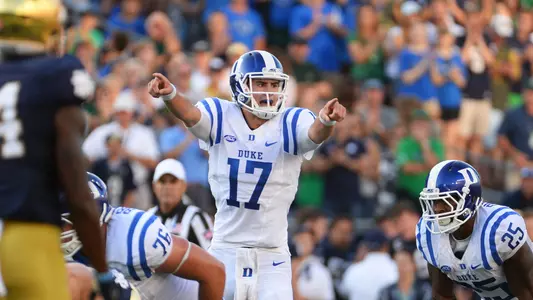
Instead, a preseason injury to Sirk thrust Jones into the starting role from the start of practice. Forced to play as freshman, Jones endured some growing pains on the field, but he also responded with the best season for any freshman quarterback in Duke football history.
Jones is the 12th freshman to start multiple games at quarterback for the Blue Devils (three more have started a single game). He had more passing yards, more total yards, more completions and was responsible for more TDs than any freshman quarterback in Duke history. In fact, here is the numerical comparison of Duke's freshmen starters:
• 1951 — Jerry Barger (started 10 of 10 games as a true freshman): Barger didn't have good passing numbers (366 yards passing; 1 TD; 10 int; 48.4 completion percentage), but he was the starter on a team that finished 5-4-1 in coach Bill Murray's first season.
• 1975 — Mike Dunn (started four games as a true freshman): 526 yards passing; 0 TDs; 7 int; 46.3 completion percentage. He was more effective as a runner, rushing for 413 yards as a freshman. Team was 2-2 in his four starts for coach Mike McGee.
• 1980 — Ben Bennett (started 10 of 11 games as a true freshman): Good stats (2,050 yards passing; 11 TDs; 25 int; 52.71 completion percentage) on a team that was 2-8 in his starts for coach Red Wilson.
• 1984 — Steve Slayden (started five games as a true freshman): 1,229 yards, 4 TDs; 9 int; 55.9 completion percentage. He was 1-5 as a starter for coach Steve Sloan.
• 1989 — Dave Brown (started three games as a redshirt freshman): 1,379 yards; 14 TDs; 6 int; 63.8 completion percentage. Brown took over the QB job late in the season and guided the team to three straight wins over Big Four rivals for coach Steve Spurrier. He totaled 1,297 yards and 11 TDs in the those three starts.
• 1992 — Spence Fisher (started six games as a redshirt freshman): 1,505 yards passing; 8 TDs; 10 int; 57.4 completion percentage. Team was 1-5 in his six starts for coach Barry Wilson.
• 1997 — Bobby Campbell (started six games as a redshirt freshman): 925 yards; 2 TDs; 10 int; 48.3 completion percentage. Team was 0-6 in his starts for coach Fred Goldsmith.
• 1997 — Spencer Romine (started four games as a true freshman): 432 yards; 3 TDs; 3 int; 52.3 completion percentage. Team 2-2 in his four starts, also for Goldsmith.
• 2003 — Mike Schneider (started eight games as a redshirt freshman): 1,220 yards passing, 4 TDs, 6 int, 46.6 completion percentage. Team was 3-5 in his eight starts for coach Carl Franks.
• 2005 — Zack Asack (started six games as a true freshman): 966 yards; 5 TDs; 8 int; 50.0 completion percentage. Team 0-6 in his starts for coach Ted Roof.
• 2006 — Thad Lewis (started 10 games as a true freshman): 2,134 yards; 11 TDs; 16 int; 52.9 completion percentage. Team 0-10 in his starts, also for Roof.
• 2016 — Daniel Jones (started all 12 games as a redshirt freshman): 2,836 yards; 16 TDs; 9 int; 62.8 completion percentage. Team 4-8 in his 12 starts for Cutcliffe.
Also: Hal Spears (1972), Anthony Dilweg (1985) and Brandon Connette (2010) started one game as freshmen.
Only Barger, who played in the two-way era, when Duke was primarily a running team, started in more victories than Jones' four. Only Brown, who stepped in at the end of an ACC championship season when starter Billy Ray was hurt, had a better TD-to-interception ratio.
But Jones accounted for more touchdowns overall. Brown was responsible for 15 TDs in 1989 (one running, 14 passing). Jones accounted for 23 — seven rushing and 16 passing.
And no previous freshman had as many yards passing. When it comes to total offense, it's not really close — in addition to his passing, Jones ran for more yards (486) as a freshman than any previous Duke QB, surpassing previous record-holder Mike Dunn's 413 yards in the UNC win. Jones' final total offense figure of 3,322 yards topped the previous freshman record holder (Thad Lewis) by more than 1,200 total yards!
Actually, the best comparison in Duke history to Jones' freshman season belongs to a sophomore — Leo Hart.
Hart played in an era when freshmen could not play varsity ball, so when he started as a sophomore in 1968, it was as if the Kinston, N.C., native was a redshirt freshman.
Like Jones, Hart was not supposed to start in his first varsity season. Duke was counting on senior Al Woodall, who would end up playing six seasons with the New York Jets, to be the starter in 1968. But Woodall ran into academic problems in the offseason and didn't return to Duke in the fall of 1968. Veteran Dave Trice was next in line, but he was hurt in preseason practice, handing the job to Hart.
The young quarterback guided Duke to an upset victory at South Carolina in his first start. He finished his sophomore year with a school record 2,238 yards passing. He had 11 TDs and 11 interceptions, and led the Devils to four wins in 10 games.
Hart's first-year passing numbers are remarkably similar after Jones' freshman stats through 10 games — even down to the 4-6 record.
Of course, that was a different era. Hart's 2,238 yards not only led the ACC, but set a conference record. Hart threw for more yards in his first season than future NFL all-stars Sonny Jurgensen, Roman Gabriel or Norman Snead had ever managed in a season.
Jones, on the other hand, plays in an ACC dominated by passing quarterbacks. At least five ACC starters will top 3,000 yards this season and another five will finish well above 2,500 yards passing. Jones is seventh in total offense — just a few yards a game behind the ACC's other freshman starter, Florida State's Deondre Francois.
Nationally, Francois and Jones are first and second in total offense among freshmen starters.
Of course, it was not a perfect freshman season for the Charlotte, N.C., native. Jones clearly struggled at times in his early games. Perhaps the best illustration of that is to track his interception record. He threw eight interceptions in his first five starts but threw just one interception in his last seven games (and that one came when he was blindsided as he threw at Georgia Tech and the ball popped in the air for an interception).
But that's just evidence of why coaches prefer to work even their most talented young quarterbacks in slowly. Even Peyton Manning threw one interception every 24.0 attempts as a freshman for Cutcliffe at Tennessee. Jones threw one interception every 47.7 attempts as a freshman for Cutcliffe at Duke.
That's not to say that Jones will develop into a better quarterback than the elder Manning, but it does suggest that we've merely seen a hint at the young quarterback's potential.
Having the best freshman quarterbacking season in Duke history is a great achievement, but it merely sets up Jones for something even more significant: Can he deliver the best quarterbacking season — of any class — in the coming years?


