By Nicole Monsalve, Duke Communications Student Assistant
Duke women's soccer alumni
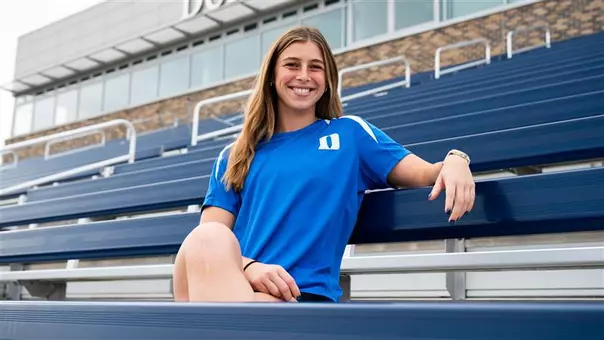
Kendall Bradley loved playing for her team in college, but unlike most student-athletes, moving on to the pros was not the ultimate goal. From a young age, Bradley knew she wanted to go into medicine, and after graduating in 2010 with more than 3,300 minutes of playing time under her belt, she hung up her cleats and attended Duke Medical School to pursue her dream of becoming an orthopedic surgeon.
"I grew up in Durham so I've been around Duke for a long time and the first orthopedic surgeon I ever met happened to be our team doctor
Alison Toth,
who did a surgery on me in high school and let me watch it," Bradley said. "Then at Duke, I shadowed her a lot just out of interest. Later when I did medical school, I had a lot of fun with every specialty but was always drawn to orthopedic surgery. I like the problems we get to fix. I like working with athletes and teams. So, I was always kind of drawn to orthopedics from that standpoint and had the opportunity to stay at Duke for residency which was awesome."
Outside of soccer, one of the main reasons Bradley chose Duke was for the CAPE (Collegiate Athlete Pre-Medical Experience) program, which provides female student-athletes at the university exposure to the world of medicine and clinical experiences.
"Women in medicine tend to be 50/50 in med school, but if you look at orthopedics which is what I'm working on its only about 10 to 12 percent women," she said. "Just being in that space and being encouraged to further yourself in the field and be confident to stick up for yourself really helped. CAPE fostered a community of other student-athletes and Baldwin Scholars, and I was around students in the same classes which helped too. The mentoring and the summer internships where you got to rotate through so many different specialties – that exposure was awesome. It was great to just have this really supportive community that gives you an exposure to medicine you wouldn't otherwise have due to the constraints of being an athlete."
While at Duke, Bradley always found herself to be supported by her teammates, coaches and counselors, and those around her always respected her ambitions to pursue a career outside of soccer.

When asked about head coach
Robbie Church, Bradley was quick to express her gratitude for his understanding and support.
"I think he's one of the best humans," she said. "He obviously cares about winning soccer games but he also just always wants to know how you're doing. He would always say he'd see me come into practice and knew I had a big exam coming up because he would say I had a look in my eyes, so he would always check in and make sure we were doing ok. I certainly grew as a soccer player, but knowing that I had other goals to get to, I just can't imagine a more supportive coach in terms of making sure I met them. The other coaching staff was great too.
Carla [Overbeck] wrote my letter of recommendation for med school,
Billy [Lesesne] was always great and supportive, and we had a variety of goalkeeping coaches who were awesome. Then the training staff had a big influence on me, both in college and when I got to work with them as a resident."
"I really can't express how proud we are of Kendall," Church said. "She epitomized the Duke student-athlete. She was such a hard worker as an athlete here. Every task she undertook, either on the field or off the field, she fulfilled it to the fullest. Her last couple years, she really turned into a leader on our team and she had her own style of leadership."
Within the team, Bradley was a part of a fairly large group of women who were also on the pre-med route. Most inspiring was
Kelly Hathorn, who despite being a couple years older, served as a great mentor for Bradley and the two even crossed paths again in med school.
Aside from the obvious disparities between being a student-athlete and a doctor, Bradley recognizes the impact that having been on the soccer team at Duke had on her career, and just how translatable the skills she learned on the field are in the operating room.
"The time management and the working as a team are things I still experience now in medicine," she said. "Especially on a surgical team, where there are so many people in the operating room that you work with and need to lead. I think that it has really prepared me well for the career I chose to go into. And of course, I'm going back to sports medicine, so even more so. Medicine has such a collaborative team environment and being on a team sport in college was awesome for that. I wouldn't have picked another college. If I could go back and do it again I would still choose duke every time and choose to be on Robbie's team."
For Bradley, experiencing Duke through different lenses – as a student-athlete, an undergrad, a medical student, a resident and now as an orthopedic surgeon and faculty – has been nothing short of incredible.
"Working with the teams as a resident was incredible because I got to see the different side of things and really appreciate the amazing resources and care that Duke medicine provides for Duke Athletics," she said. "It's really unparalleled at Duke just how much they work together and the access and collaboration between the two groups is really just special. I got to spend time with the women's soccer team, which was really fun for me as a resident. I worked closely with the football team, which was a fun experience getting to work with
Hap [Zarzour] and
Kyle [Beatty], who were just great people. It's amazing to see how invested they still were – they were all in on the fact that I was a former Duke student-athlete and wanted to make that a great experience for me, which it was.
"I am once again finding that the passion I felt has carried over from when I was a college kid to now being in my 30s and finishing my medical education."

Dr. Bradley, a lifelong fan of the Bull City, is happy to be coming back home to rejoin the Duke family as an assistant professor in the sports medicine division of the orthopedic surgery department, seeing sports patients of all ages in addition to working with varsity teams. She now finds herself in the position to share advice and perspective for current student-athletes with aspirations of one day becoming a doctor, as her journey will forever trace back to her years as a Blue Devil.
"Just try to get as much exposure to the field as you can and try and find good mentors that are going to help you along the way," Bradley said. "I wouldn't be in the position I am now without the mentors that I've had and to diversify your mentors is really important. I had obviously Robbie from a life standpoint and then people like Dr.
[Alison] Toth, who after my parents is probably the most influential adult in my life, as well as
Allan and
Henry [Friedman], who are in the oncology and neurosurgery field. Diversifying your mentors, finding people who are going to help you along the way, and not being afraid to reach out to those people and bug them and have them be involved in your life."
According to Church, Bradley's commitment to excellence while helping others will never be in doubt, just as he saw when she donned the blue and white jersey.
"She wasn't one of our more athletic players when she came to Duke, but through her hard work and determination, she put herself on the field for us," Church said. "That has carried over to what she is doing off the field. For her to get a position like this is absolutely phenomenal. We know she'll do a wonderful job and our student-athletes are in fantastic hands."
#GoDuke


.png&width=24&height=24&type=webp)