
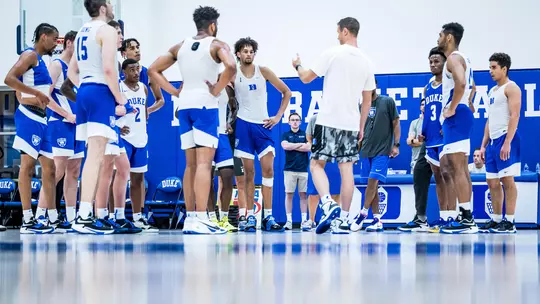
GoDuke The Magazine: First Time in Charge
Scheyer joins lineage of new ACC head coaches
Barry Jacobs, GoDuke The Magazine
The ACC has been around for going on 70 years pending further expansions and reshuffles. During the league’s existence, counting extended interim appointments, records indicate that, entering the 2022-23 season, there have now been 92 head men’s basketball coaches at 17 schools.
Remarkably, given the high stakes at the ACC level, many of those bench bosses, including several Hall of Famers, did not launch their conference careers with college head coaching experience. Still, nobody came to his job in quite the deliberate, public manner of new Duke coach Jon Scheyer, an alumnus who never previously directed his own program.
Most coaching changes come abruptly, at least as far as the outside world can tell. Sometimes precipitous change is initiated by an incumbent coach — a Bucky Waters or Dean Smith walks away from his job with little warning on the eve of fall practice, as happened at Duke in 1973 and UNC in 1997. Or Roy Williams steps down at Carolina in the emotional aftermath of disappointing 2020 and 2021 seasons.
Scheyer’s ascendance to the head job took an opposite route, aptly illustrating the deliberate benefits of designating a so-called “coach-in-waiting.” His promotion was announced a year in advance, the reality of his pending command overshadowed by Mike Krzyzewski’s efforts to coax one last set of championships from a platoon of transient hotshots. With so much attention paid to that quest, Scheyer’s year of overt apprenticeship passed with muted scrutiny.
Quite frankly there wasn’t all that much to say. He was a smart player at Duke from 2007-10, a court commander who got by as much on intelligence and hard work as athleticism. Scheyer and backcourt mate Nolan Smith led the 2010 Blue Devils to what was easily the most unexpected of Krzyzewski’s five titles.
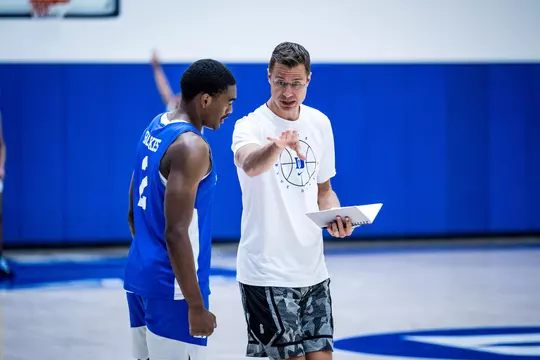
The well-spoken Scheyer was 33 when confirmed as Coach K’s successor at a June 2021 press conference. Those who’ve labored alongside Scheyer praise him as a hard worker, a basketball thinker, a quiet but determined leader. In his playing days the Illinois product was an All-American and two-time team captain. (He’s also, incidentally, only the third Jewish head coach in ACC history after Clemson’s Larry Shyatt and Virginia Tech’s Seth Greenberg.)
As for a trail of achievement at the helm, other than two-and-a-half fill-in efforts in games while Krzyzewski was out, there isn’t one. Conventional thinking and superlative recruiting anticipate success, but guesses don’t count.
Schools enlist green leaders more commonly than you might think, even in a prestigious league where benches bristle with veteran coaches. Quite often the first-time coaches are alums. Just this season Louisville hired former Cardinals player Kenny Payne, whose coaching experience is as an assistant in college and the pros.
Such choices have been made since the ACC’s early days. Many turned out quite well.
Think Vic Bubas, retired in 1969 after 10 highly successful years at Duke, the only head coaching job he ever held. Bubas came to Duke during the spring of 1959 after a stint as an assistant under Hall of Famer Everett Case at N.C. State. Case had built the dominant program in the region, winning 9 of 10 league tournament titles — and thus secured the single available NCAA Tournament bid — in the Southern and Atlantic Coast conferences from 1947 through 1956.
Case, by the way, was hired at N.C. State lacking collegiate experience, coming directly from a high school coaching turn in Indiana. That result was far more successful than the Maryland tenure of Baltimore prep coach Bob Wade. He lasted three seasons and earned a crushing probation for the school.
To compete with Case, North Carolina hired future Hall of Famer Frank McGuire, fresh from directing St. John’s to the 1952 Final Four. Half a decade later McGuire’s Tar Heels went undefeated, running off 32 straight wins to capture the 1957 NCAA championship behind Player of the Year Lennie Rosenbluth.
Uncomfortably left behind, Duke hired the innovative Bubas, a masterful program salesman and a notably wide-ranging, well-organized recruiter. Bubas had played guard under Case, then worked beside him, rising to be Case’s chief assistant. His first season at Durham was also his first as a head coach.
Setting a precedent to be followed successfully by two University of North Carolina coaches, and hopefully by Scheyer, Bubas immediately led the Blue Devils to a surprising ACC Tournament title in 1960 and an advance to the NCAA regional finals.
Following the 1961 season McGuire was invited to leave Chapel Hill, his recruiting shenanigans earning NCAA probation. He was replaced by unknown assistant Dean Smith. Bubas and Smith, both arguably risky hires, were each 30 years old upon becoming head coaches at Duke and UNC, respectively.
Smith, like Scheyer, played guard on an NCAA championship team, although he rode the bench for Kansas, coached by Hall of Famer Phog Allen, when it beat McGuire’s St. John’s squad in the 1952 NCAA title game.
Smith reached Hall of Fame status sporting two NCAA titles, 11 Final Four trips, and 879 wins over 36 seasons. Upon retirement he was replaced by Bill Guthridge, his 30-year assistant. Some suspected Smith cleverly orchestrated his departure to leave little chance North Carolina would hire anyone but Guthridge, a head coaching novice.
In three seasons running the UNC program Guthridge took the Heels to a pair of Final Fours. His 1998 team’s advance to the national semifinals one-upped Bubas and all other first-time ACC coaches.
Until last year, that is, when Hubert Davis, Roy Williams’ bench replacement, took UNC to the national championship contest. (Williams himself built a Hall of Fame career lacking previous head coaching chops, starting at Kansas in 1988-89.)
Scheyer also belongs to a select group of ACC coaches-in-waiting. Long before Scheyer’s birth, Petar “Press” Maravich was hired as an assistant at N.C. State with the thought he’d eventually replace Case, whose health was failing. Early in the 1964-65 season Maravich, with head coaching experience at Clemson, did in fact succeed Case and led the Wolfpack to the ’65 ACC Tournament title.
Then there was Syracuse alum Mike Hopkins, officially dubbed “Head Coach-Designate” by the school a decade ago when the concept was all the rage in college circles, usually in football.
Hopkins, a 22-year assistant without head coaching experience, actually got to direct Syracuse to a 4-5 record in 2015-16 while Hall of Famer and alumnus Jim Boeheim was suspended for NCAA recruiting violations.
Boeheim was yet another untested assistant upon jumping to head coach in 1976-77, nearly 40 seasons before the Orange joined the ACC. He returned to the bench and soon Hopkins was off to coach the University of Washington. No subsequent replacement for Boeheim, 77, has been named.
Meanwhile, after contemplating Scheyer’s reign for more than a year, we get to see where he fits in the coaching continuum. He has a chance to be the most successful first-year ACC head coach ever — all he must do is lead his ’23 Devils to three more wins than Bubas’ maiden effort, two more than Guthridge’s, and one beyond Davis to win an NCAA championship.
Dedicated to sharing the stories of Duke student-athletes, present and past, GoDuke The Magazine is published for Duke Athletics by LEARFIELD with editorial offices at 3100 Tower Blvd., Suite 404, Durham, NC 27707. To subscribe, join the Iron Dukes or call 336-831-0767.