
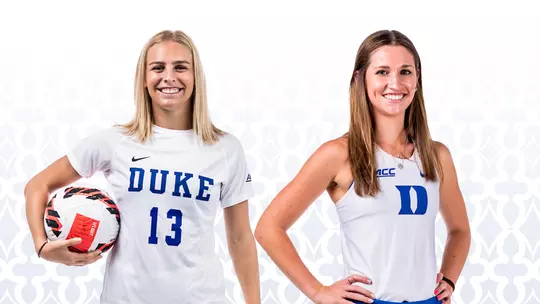
Impact Leaders
Postgrad scholarships honor soccer's Emily Duerr, cross country's Caroline Howley
Meredith Rieder, GoDuke The Magazine
This story originally appeared in the 14.11 Issue of GoDuke The Magazine – June 2023
The path to a destination is not always straight. For recent Duke graduates Emmy Duerr and Caroline Howley this could not be truer as their routes to becoming Duke student-athletes featured difficult decisions, happenstance meetings and personal perseverance.
Regardless of how Duke landed the ambitious Duerr and Howley, four-year members and leaders for their respective women’s soccer and women’s cross country teams, Duke Athletics is fortunate the windy roads ultimately led the pair to Durham.
Duerr and Howley, exceptional leaders inside and outside of the athletic arena, recently were awarded the Heidrick Family Leadership Post Graduate Scholarships for “not only for what they have contributed to the leadership community within Duke Athletics but also by who they are as people, how they have grown in the area of leadership and how they have used their leadership development to enhance the community during their undergraduate career at Duke University,” the selection committee stated.
Established through a gift by Bob Heidrick and his family, the $10,000 scholarships to be used for postgraduate education are given annually to two recipients. The selections are viewed as an investment in the individual rather than based on the athletic accomplishments of the person.
They certainly made sound investments in Duerr and Howley.
From serving as leaders for Team IMPACT, helping enrich young kids facing chronic illnesses, to representing a team on the Student-Athlete Advisory Council (SAAC) and Duke’s Diversity, Equality, Inclusion and Belonging (DEIB) task force, to taking on leadership roles in academic programs, Duerr and Howley are undeniably future leaders in their professional fields. They managed all this while being dedicated athletes and maintaining near 4.0 GPAs.
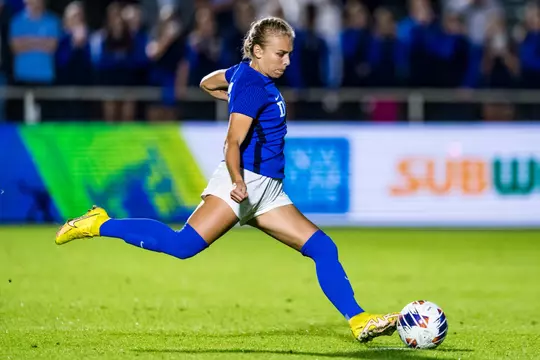
Duerr, a native of Cary, N.C., grew up attending the women’s soccer camps with her club team so she aspired to be a Blue Devil for much of her life. She idolized the Duke players then. Little did she know she would find herself in that same position years later and would be able to leverage her platform as a Duke student-athlete to do great things within the Duke and Durham community.
For Howley, she first learned about Duke at age nine when she was making her March Madness picks for the 2010 NCAA championship and she picked the Blue Devils to win. When Butler’s halfcourt shot bounced off the rim leaving the Blue Devils to celebrate their fourth NCAA title, Duke became a dream for her.
“From then on,” she said, “I would always pick Duke in March Madness and I said ‘I’m going to go to Duke. That’s my dream school.’”
What makes Duke such a dream — the combination of high-level academics and elite athletics — is also what makes it so difficult to become a Blue Devil student-athlete. Duerr and Howley both understood their athletic abilities were not quite up to the high Duke standard, meaning they might have to give up that aspect of their life.
“I think having decommitted from another school and applying as a regular student (to Duke) there were definitely a couple of months where I was prepared to be a non-college athlete and be prepared to go to Duke as a regular student,” Duerr said.
Committed to attend and play soccer at another school when she was a freshman in high school, Duerr’s plans took a turn when she saw her SAT scores and realized Duke was in the picture for her as a regular student.
“When I got my SAT scores back and with my GPA, I thought ‘I can probably shoot for my dream school,” Duerr said. “So I applied to Duke and got in as a regular student and walked on to the soccer team. Duke was definitely a dream. It wasn’t realistic for a long time, but everything worked out really nicely.”
It was a literal run-in between Duerr and Duke women’s soccer head coach Robbie Church the summer prior that sealed the decision for the Cardinal Gibbons graduate. Duerr was playing in a summer tournament and Church was there looking for future Blue Devils when Duerr turned a corner and ran smack into the Blue Devil head coach.
“I was late for something, and we just ran into each other,” Duerr said. “I thought to myself that this is probably the moment I should test this out. So, I ended up talking to him and that’s how (me walking onto the team) started to unfold.”
Committed to attend and play soccer at another school when she was a freshman in high school, Duerr’s plans took a turn when she saw her SAT scores and realized Duke was in the picture for her as a regular student.
“When I got my SAT scores back and with my GPA, I thought ‘I can probably shoot for my dream school,” Duerr said. “So I applied to Duke and got in as a regular student and walked on to the soccer team. Duke was definitely a dream. It wasn’t realistic for a long time, but everything worked out really nicely.”
It was a literal run-in between Duerr and Duke women’s soccer head coach Robbie Church the summer prior that sealed the decision for the Cardinal Gibbons graduate. Duerr was playing in a summer tournament and Church was there looking for future Blue Devils when Duerr turned a corner and ran smack into the Blue Devil head coach.
“I was late for something, and we just ran into each other,” Duerr said. “I thought to myself that this is probably the moment I should test this out. So, I ended up talking to him and that’s how (me walking onto the team) started to unfold.”
Howley’s story of becoming a Blue Devil had many of the same parallels as Duerr’s as the McLean, Va., native went back and forth on deciding to apply to Duke, accepting she might not be a member of an athletic team, to an unexpected connection that ultimately pushed her to don the Duke jersey.
After her sister Kathryn decided to attend Duke, Howley took a step back from Duke thinking she wanted to blaze her own path. However, when it came time to decide on where she’d spend the next four years, Duke proved to be ultimate dream and like Duerr she was prepared to be just a “regular student.”
“I wasn’t quite good enough to run at Duke,” Howley said. “So, when it came time to choose a college I wanted to apply to I was really torn between going somewhere I didn’t like as much just to run or going to Duke and kind of sacrificing the running. I ended up choosing (Duke) because I thought to myself, ‘I can train for a marathon or I can run on my own.’”
Faster times and success as a senior gave Howley confidence she could run for the Blue Devils. She reached out but was told there wasn’t enough space on the team for her at the moment. A little disappointed, but understanding the decision, Howley worked that summer at Smoky Mountain Running Camp with middle and high school runners. That’s where she met Georgia Tech cross country head coach Alan Drosky, who gave wind to her sail.
Howley’s story of becoming a Blue Devil had many of the same parallels as Duerr’s as the McLean, Va., native went back and forth on deciding to apply to Duke, accepting she might not be a member of an athletic team, to an unexpected connection that ultimately pushed her to don the Duke jersey.
After her sister Kathryn decided to attend Duke, Howley took a step back from Duke thinking she wanted to blaze her own path. However, when it came time to decide on where she’d spend the next four years, Duke proved to be ultimate dream and like Duerr she was prepared to be just a “regular student.”
“I wasn’t quite good enough to run at Duke,” Howley said. “So, when it came time to choose a college I wanted to apply to I was really torn between going somewhere I didn’t like as much just to run or going to Duke and kind of sacrificing the running. I ended up choosing (Duke) because I thought to myself, ‘I can train for a marathon or I can run on my own.’”
Faster times and success as a senior gave Howley confidence she could run for the Blue Devils. She reached out but was told there wasn’t enough space on the team for her at the moment. A little disappointed, but understanding the decision, Howley worked that summer at Smoky Mountain Running Camp with middle and high school runners. That’s where she met Georgia Tech cross country head coach Alan Drosky, who gave wind to her sail.

“He was kind of shocked when he found out I wasn’t running in college and basically convinced me to give it another go,” Howley said. “He was kind enough to give me a training plan and said in the fall I should race unattached in different meets and he was convinced I would run a fast enough time where the Duke coach would want me.”
Howley heeded his advice, followed his training plan and paid to enter a couple of early races. It turned out Drosky was right as Duke’s head coach at the time, Rhonda Riley, called her and invited her to join the team. In mid-October, Howley was officially a Blue Devil. While both had circuitous routes to their respective Blue Devil teams, there was no hesitation or consideration of doing anything but diving head-first into activities outside of sport.
Duerr, always having to be on the move and engaged, took the lead for Duke with Team IMPACT, becoming the Duke campus, Mid-Atlantic and ACC representative for the national nonprofit organization that connects children facing serious and chronic illnesses with college athletic teams, allowing the children to become official team members.
She was instrumental in developing relationships with the children and their families as well as getting other Blue Devil teams involved. Through her efforts and dedication with Team IMPACT, Duke was named the recipient of the 2023 Team IMPACT Division I Fellowship Campus of the Year Award, recognizing the department for their efforts in building relationships with those young kids involved in the organization.
Howley, who got a glimpse into what it was like to not be a student-athlete, was inspired by the friends she made upon arrival to Duke. She saw how they were immersing themselves in clubs and activities they were passionate about so when she was invited to be a member of the cross country team she wanted to do the same.
Howley joined Duerr in Team IMPACT, forming the connection with the match for the track and field program. She also was the cross country team’s representative on SAAC and Duke’s DEIB committee, facilitating professional development and community service opportunities for fellow student-athletes. And she put her economics major to use as the Event Management Director of the Duke Sports Business Club.
Always having plans of becoming a doctor, Duerr joined the Collegiate Athlete Premedical Experience (CAPE) as a sophomore and eventually became a team ambassador. CAPE was a huge influence on Duerr’s decision to be a student-athlete and like she did with community service, she did it to her best.
“When Robbie told me about the CAPE program, that was probably one of the biggest reasons I decided to play soccer. It’s a program and an experience you don’t get anywhere else in the country. I met a lot of really amazing female mentors for me that have really served me through the (medical school) application process. I just gained a lot of incredible experience.”
The program also taught Duerr she wanted to go into surgery. During her internship with the program last summer, Duerr said she was exposed to 16 or 17 different specialties and witnessed how she can transfer her qualities acquired from being a leader on the soccer team to being a successful healthcare professional.
“Increasingly, healthcare is becoming a very collaborative experience,” Duerr said. “It is very team-based and requires complete connection from start to finish. My experience playing a team sport is going to be very valuable to have that kind of skill and capability to communicate very clearly with people from different backgrounds playing different roles and just being able to seamlessly make that whole operation work.”
Howley, ultimately wanting to work in the financial investment field on environmental and sustainability-related projects, excelled in Duke’s Bass Connections program. Through her three years on an interdisciplinary team in the program, Howley witnessed how being a member of an athletic team will transfer to her postgraduate life.
The program bridges the classroom and the real world, allowing students an opportunity to tackle complex societal problems alongside faculty from Duke. The students form interdisciplinary teams and collaborate with professors on cutting-edge research that spans subjects, demographic groups and borders.
Always having plans of becoming a doctor, Duerr joined the Collegiate Athlete Premedical Experience (CAPE) as a sophomore and eventually became a team ambassador. CAPE was a huge influence on Duerr’s decision to be a student-athlete and like she did with community service, she did it to her best.
“When Robbie told me about the CAPE program, that was probably one of the biggest reasons I decided to play soccer. It’s a program and an experience you don’t get anywhere else in the country. I met a lot of really amazing female mentors for me that have really served me through the (medical school) application process. I just gained a lot of incredible experience.”
The program also taught Duerr she wanted to go into surgery. During her internship with the program last summer, Duerr said she was exposed to 16 or 17 different specialties and witnessed how she can transfer her qualities acquired from being a leader on the soccer team to being a successful healthcare professional.
“Increasingly, healthcare is becoming a very collaborative experience,” Duerr said. “It is very team-based and requires complete connection from start to finish. My experience playing a team sport is going to be very valuable to have that kind of skill and capability to communicate very clearly with people from different backgrounds playing different roles and just being able to seamlessly make that whole operation work.”
Howley, ultimately wanting to work in the financial investment field on environmental and sustainability-related projects, excelled in Duke’s Bass Connections program. Through her three years on an interdisciplinary team in the program, Howley witnessed how being a member of an athletic team will transfer to her postgraduate life.
The program bridges the classroom and the real world, allowing students an opportunity to tackle complex societal problems alongside faculty from Duke. The students form interdisciplinary teams and collaborate with professors on cutting-edge research that spans subjects, demographic groups and borders.
“I was part of the team for three years in total and having the opportunity to develop my own research topic, while also being able to interact with teammates in an interdisciplinary fashion (was incredible),” Howley said. “I could bring my expertise to certain parts of (another person’s) project and they could bring theirs to mine. It was a great way to learn collaboration in a bit more of an academic sense.”
Regardless of whether in an academic setting, on the soccer field or in the middle of a 6K race, it was clear Duerr and Howley both had an innate ability to lead. They were empathetic, driven and displayed to everyone the value of investing in yourself and your community.
Their teammates recognized this. Duerr was voted team captain as a senior, and while Howley didn’t have the captain title, she was respected and a source of inspiration to her fellow runners.
Duerr calls being voted a captain by her teammates one of her greatest accomplishments.
“Being voted captain after walking onto the team was something I never ever ever would have dreamed of,” she said.
In Howley’s personal statement for the Heidrick Scholarship she admitted she didn’t truly see herself as a leader. It really wasn’t until she read a note from her teammates that she realized how impactful she was as a person.
“At senior day, my teammates wrote me a note which included: ‘You have showed us how to work hard on the track and in school, be bold yet consistent, and most importantly, how to pave our own paths.’”
If you take anything away from Duerr and Howley, engage within your community, take a leap of faith and remember paths to success are not meant to follow a straight line.
“I was part of the team for three years in total and having the opportunity to develop my own research topic, while also being able to interact with teammates in an interdisciplinary fashion (was incredible),” Howley said. “I could bring my expertise to certain parts of (another person’s) project and they could bring theirs to mine. It was a great way to learn collaboration in a bit more of an academic sense.”
Regardless of whether in an academic setting, on the soccer field or in the middle of a 6K race, it was clear Duerr and Howley both had an innate ability to lead. They were empathetic, driven and displayed to everyone the value of investing in yourself and your community.
Their teammates recognized this. Duerr was voted team captain as a senior, and while Howley didn’t have the captain title, she was respected and a source of inspiration to her fellow runners.
Duerr calls being voted a captain by her teammates one of her greatest accomplishments.
“Being voted captain after walking onto the team was something I never ever ever would have dreamed of,” she said.
In Howley’s personal statement for the Heidrick Scholarship she admitted she didn’t truly see herself as a leader. It really wasn’t until she read a note from her teammates that she realized how impactful she was as a person.
“At senior day, my teammates wrote me a note which included: ‘You have showed us how to work hard on the track and in school, be bold yet consistent, and most importantly, how to pave our own paths.’”
If you take anything away from Duerr and Howley, engage within your community, take a leap of faith and remember paths to success are not meant to follow a straight line.
Dedicated to sharing the stories of Duke student-athletes, present and past, GoDuke The Magazine is published for Duke Athletics by LEARFIELD with editorial offices at 3100 Tower Blvd., Suite 404, Durham, NC 27707. To subscribe, join the Iron Dukes or call 336-831-0767.