DURHAM, N.C. – The Duke Alumna Spotlight this week features
Mary Wilson, a 2016 graduate who helped the Blue Devils reach unprecedented success in her senior season.
During her final spring campaign at Duke – and the first of Head Coach
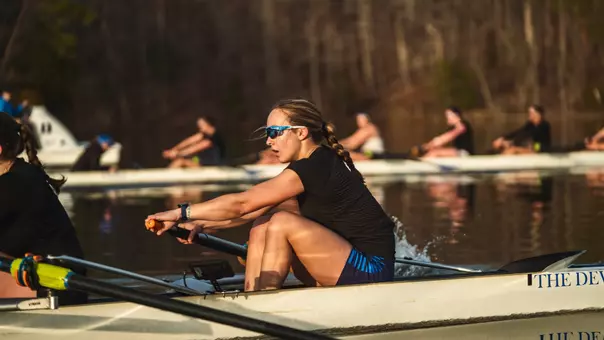
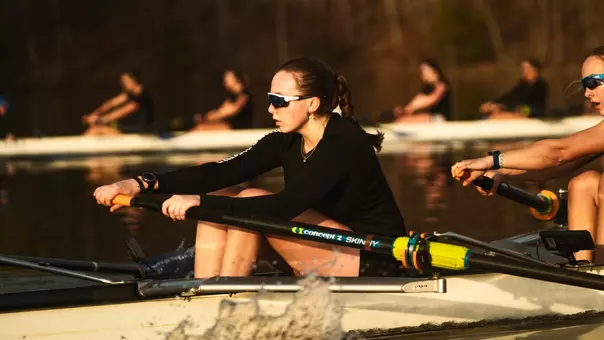
Megan Cooke Carcagno's tenure – "MJ" emerged as the anchor of the varsity-4 boat, leading the group to a second-place finish at the ACC Championship. The result spearheaded a silver medal team performance that ultimately earned the program its first-ever bid to the NCAA Championships two weeks later. That Memorial Day weekend in Sacramento, Calif., Wilson and the V4 squad placed first in the C/D semifinal to claim a spot in the C Final, which they took first in with a time of 7:22.311.
Her standing within the program as a premier contributor was not always such, however. Over her first three seasons, Wilson competed in the 2V4, 2V8 and 3V8 boats, and until Cooke Carcagno's arrival she had to consistently adapt to different lineups. Her stops since graduating from Duke have shared that variation, as she has lived in three different cities and reshaped her career path over the past four years.
Wilson describes her professional trajectory as a "winding road" and "an adventure," and her experiences within different jobs would certainly indicate that. She maintains that her interest in how people and systems worked, along with her fascination in building things and implementing new programs, led her to finding Venture for America, a nonprofit fellowship program for recent graduates who want to become entrepreneurs.
Through her training experience, Wilson was able to land a position as an investment analyst with JumpStart Inc., where she would help establish and provide resources for early-stage technology startups in Ohio. After moving to Cleveland, she became increasingly invested in both the ability to connect with innovative entrepreneurs and the familial environment that Venture for America provided – something that she could compare to her experience as a student-athlete at Duke.
"Being on the rowing team showed that I love being a part of a bigger community and a team, and I really felt that with Venture for America," Wilson said. "I was really fortunate to get this role in a venture capital firm where I was able to see these new technologies and help vet them and understand what made something more high-potential and willing to take that economic risk on them."
Wilson admits that she knew very little about the Cleveland area prior to moving – including learning that it is geographically tied to Lake Erie and the Cuyahoga River during her interview. And while she was content to believe that rowing after college was unlikely, a local opportunity to become involved once again with the sport was enough to reignite her passion.
"Coincidentally, there was a rowing community center that was being developed at the time," she said. "It was in its very early stages when I first got there. I was introduced to the coach there – the head coach of the junior team – and I became an assistant coach with them. Through that, I had this inkling that I wanted to keep rowing. I trained a little bit, I organized the Head of the Charles 8 that fall and then I was pretty hungry to get out in the water.
"I was able to piece things together, work with a lot of people and then I began racing competitively that summer, which has been really cool."
After joining The Cleveland Foundry club in 2017, Wilson dove into competition again, taking part in regattas like the Head of the Charles and the Canadian Henley. She also appeared at the U.S. Rowing National Championships that year, where she placed third in the Intermediate Lightweight Singles Division. With it being her first competitive race in a single, Wilson said that the result surprised her, but it was enough for her to know that rowing would remain important, even if that would require more balance when it came to her professional life.
While her colleagues within Venture for America provided her with a network of friends that helped her navigate a new city, Wilson still recognized the difficulties that one could face in their first experiences after college. Through this acknowledgement, she and another 'VFA' fellow in Baltimore, Md., began researching how to build support systems for people who were experiencing the loneliness of a new home. From there, she moved to the Detroit area to start and serve as the CEO of Homecity, a company that organized immersive experiences that were designed to help people explore their city and form relationships.
"I thought 'This is something that, in this stage of my career, I'm willing to take a risk on,'" Wilson said. "This is a problem that is big enough and important enough to me that I would like to work on it. Within the accelerator, I got there and it was a whirlwind – a totally different experience. [It was] a lot of fun and had a lot of learning opportunities."
As she still worked to build and develop Homecity, Wilson reflected on what she wanted her career to look like long-term. She did so through volunteerism, making stops at a co-living space and later a Detroit hospital. For Wilson, this experience showed her an area where she could utilize her skillset while building a foundation for her future. Her distinct interest in the medical field led her to explore her options and ultimately commit to a new career path, as she then applied to a postbaccalaureate premedical program at Bryn Mawr College in the Philadelphia area.
She began studying at Bryn Mawr in May of 2019, and while many others have spent the past few months during the COVID-19 pandemic looking for ways to fill time, Wilson has done so studying for the MCAT Exam. Through the versatility that she has displayed since graduating, she carries with her many morals that were instilled during her time with the Blue Devils rowing program.
"I think the oversimplified message in the world is 'You work hard and you get the thing and it's great.' Rowing kind of showed me the leadership. The senior year transformation that we had, given the almost identical pool of athletes – I was able to go from the lowest boat my junior year, and then my senior year, my boat had the best performance record of the Duke rowing boats, and I was leading that. I was working so hard, but also realizing that there's different ways to work hard and achieve success.
"It's not just that you have to work hard. It's also, what is a good plan? Do you have this good level of respect and trust among the athletes and the coaches? Especially as I've transitioned to lightweight rowing, where it's me out in my single and I have to weigh 130 pounds and have all these other confounding variables in my life – I've had to go to school and be working – it's realizing what are the different levers you can pull that aren't just 'I'm going to work hard.' Then, also realizing that so much of the race is actually while you're on the recovery of the stroke. So much of it is about how you're setting yourself up for that next push. Just thinking about all these ancillary effects that contribute towards achieving what you are hoping to achieve."
In every stop along the way, one aspect of Wilson's life that has remained the same has been rowing. After her time with The Foundry, she raced for Detroit Boat Club and most recently competed for Vesper Boat Club in Philadelphia. While her goal now is to become a physician, she has participated in multiple national selection events over the past few years – both in singles and in a pair – and placed sixth in the women's lightweight singles final at the most recent Head of the Charles.
As she looked to compete nationally, Wilson often went back to her college roots, receiving enviable guidance from a former U.S. national team veteran in Cooke Carcagno.
"I've been in contact with Megan more post-graduation, and asking about advice or feedback in terms of navigating this whole elite rowing world, and that has been really phenomenal," Wilson said. "To see her, especially as a smaller, open-weight athlete that was on the national team for so long – that was incredibly inspiring to me."
Wilson feels that NCAA and post-graduate rowing each offer their own benefits, but when it comes to reminiscing on her former coaches and teammates, she recalls her four years at Duke fondly. Particularly, her relationship with Associate Head Coach
Chase Graham, who worked primarily with the varsity-4 boat during her senior year, helped shape her improvement that season and ultimately her approach in her current rowing career.
"In terms of the day-to-day trust foundation and relationship, I spent most of my time working with Chase," she said. "That was really phenomenal. He doesn't say much, but when he says something, it's either a joke or it's something very helpful that helps your rowing quite a bit. It's just that quiet steadiness of desire to keep pushing and keep going after it without overstating anything that I definitely appreciated about his style and about working with him."
When she reflects on the success both she and the team found during that spring of 2016, she makes sure never to forget the process that was put in place years earlier, when the dream of competing at the NCAA Championships was first established. To Wilson, her achievements as a senior could only be partly attributed to herself.
"I think even more so, it's the work that so many of the athletes before us put into it," she said. "I especially think that we've had phenomenal seniors every year – the class of 2013, '14 and '15. That was always the goal since I was a freshman, was to make it to NCAAs, and so I feel like it was just as much for them as it was for me. I felt like I was lucky to be able to be an athlete in that boat during that time to help make it happen."
Wilson says that she still remains in close contact with some of her former teammates, talking to some as often as multiple times a week. One connection that she knows will never be broken is the one she shares with the rest of her varsity-4 lineup, as the standard they set remains tangible for the current team. Even away from the water, Wilson utilizes her Duke rowing connections in the professional field, citing the advice she seeks from her varsity-4 coxswain,
Sarah Wall.
"She was one of the first people I reached out to when I was thinking about making this transition into medicine," Wilson said. "I also reached out to
Elizabeth Howell and several other rowers who already knew a long time ago that they wanted to be doctors. That has been a really unique part, is being able to get that support from my teammates as I've made this different transition."
No matter where her professional life takes her, Wilson knows that rowing will keep its place. Both at Duke and in club circuits, she takes the values and lessons from the sport and applies them to her own occupation. And as she has discovered in her four years since graduating, the Duke rowing family will always remain a source of guidance, inspiration and memories.
#GoDuke